
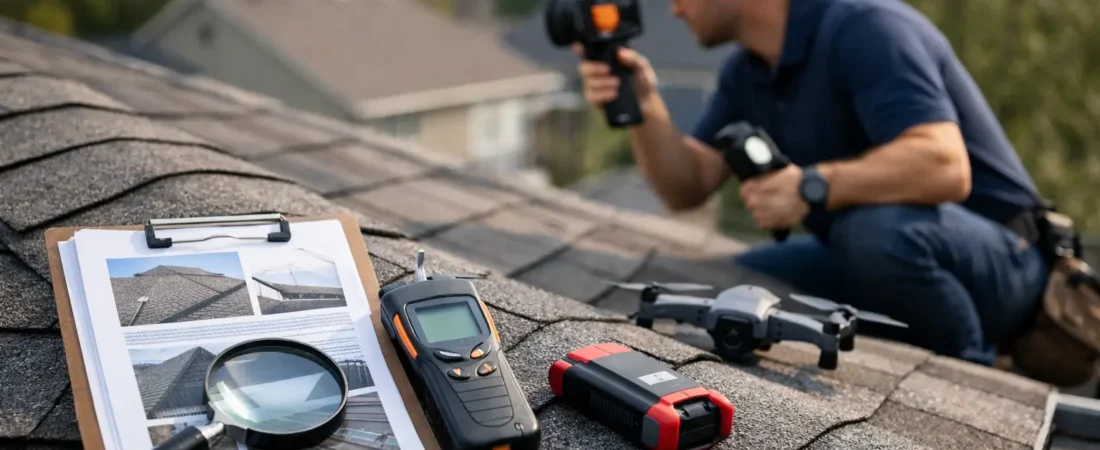
A roof can look acceptable from the driveway and still carry a costly problem at ridge level, beneath a flat-roof covering, or around a chimney flashing. The best pre-purchase inspection add-ons are not extras for the sake of a longer report. They are targeted checks that answer the questions a standard visual roof assessment cannot always settle from ground level.
For buyers, investors and agents, the right scope depends on the property, its age, its roof design and the evidence already visible. A well-chosen add-on can turn an uncertain observation into a clear recommendation: proceed, renegotiate, budget for repairs, or investigate further before contracts are finalised.
Why a basic roof assessment may need more detail
A professional roof inspection should establish the apparent condition of the main coverings, flashings, gutters, roofline, chimneys, drainage points and visible signs of water ingress. That provides a strong starting point. However, some risks are concealed by height, access limitations, recent repairs or finishes that look sound but are approaching the end of their serviceable life.
This is particularly relevant to older Dublin and surrounding county properties, where original slate, patched felt coverings, ageing valleys and altered chimney details are common. It also applies to newer properties with complex roof layouts, roof lights, low-pitch sections and concealed gutters.
The goal is not to order every available service. It is to match the inspection scope to the financial decision in front of you. A modest extension with a simple pitched roof may need only a focused drone review, while a large detached property with multiple roof levels may justify a more detailed moisture investigation and roof certification assessment.
Best pre-purchase inspection add-ons for roofs
Drone roof inspection and high-level imagery
Drone imagery is often the most useful add-on where roof slopes are steep, access is restricted, or the building has several levels. It allows close visual coverage of areas that cannot be assessed reliably from the ground, including ridge tiles, valleys, parapet copings, leadwork, roof lights and the upper courses of slate or tile.
High-resolution photographs matter because they give buyers and advisers evidence they can review after the visit. Rather than relying on a verbal comment that a chimney appears weathered, you can see open mortar joints, displaced flashings or damaged pots in context.
A drone inspection is especially worthwhile for properties with high roofs, rear extensions, dormers or inaccessible garden elevations. It is a visual assessment, so it cannot confirm every concealed defect beneath the covering. Even so, it is one of the fastest ways to reduce uncertainty without intrusive work.
Leak investigation where there are interior warning signs
A water stain, bubbling paint, damp patch near a roof window or discoloured ceiling does not automatically identify the point of entry. Water can travel along timbers, membranes or masonry before becoming visible indoors. A targeted leak investigation is designed to trace the likely route and distinguish an active defect from historic staining.
This add-on becomes valuable when a seller says a leak has been repaired, but the surrounding evidence is unclear. It can assess likely failure points such as flashings, valleys, roof penetrations, gutter overflows and junctions between old and newer roof sections.
There is a practical limitation: weather conditions influence what can be confirmed on the day. Dry conditions do not mean a roof is watertight, and recent heavy rain may reveal a problem that is otherwise difficult to reproduce. A clear report should explain the evidence observed, the probable cause and any limits on certainty.
Moisture checks in accessible roof spaces
Where safe access is available, moisture assessment within the roof space can add valuable context to the external inspection. It may identify damp timbers, water marking, degraded underlay, condensation patterns or evidence of previous ingress that is not obvious from outside.
This is not a substitute for examining the roof covering. It is a complementary check that helps establish whether an external defect has affected the structure beneath. For a buyer considering a period property, it can be particularly useful where the roof has been re-covered at some point but the condition of the supporting timbers is uncertain.
Results need careful interpretation. Condensation, old staining and active rainwater entry can look similar at first glance. The report should separate confirmed findings from areas that require monitoring or repair, rather than treating every mark as an urgent failure.
Chimney and leadwork assessment
Chimneys are a frequent source of avoidable roof repairs. Their exposed position means they are vulnerable to cracked render, deteriorated pointing, loose pots, failed flashing and defective soakers. These details are small compared with the roof area, but a failure around a chimney can allow persistent water entry.
A dedicated chimney assessment is sensible where a property has multiple stacks, older brickwork, signs of movement, vegetation growth, staining below the stack or patch repairs around the flashing. It is also useful when a chimney has been altered, capped, or partly removed, as these changes can create weak points at the roof junction.
The value is not simply identifying visible defects. It is setting out repair priorities. Repointing a few open joints and renewing local flashing are very different decisions from rebuilding unstable brickwork or carrying out major leadwork repairs.
Flat roof condition assessment
Flat and low-pitch roofs deserve specific attention because water drainage, seams, upstands and edge details have a direct impact on their life expectancy. A surface that appears tidy may still have ponding, brittle membranes, split joints or weak detailing at roof lights and parapets.
For a property with a rear extension, bay roof, garage or balcony roof, a focused flat-roof assessment can help establish whether repairs are localised or whether replacement should be expected in the near term. The inspection should record the covering type where identifiable, visible defects, drainage arrangement and signs of previous patching.
Age alone does not decide the condition of a flat roof. A well-maintained covering may continue to perform, while a newer installation with poor drainage can deteriorate quickly. This is why photographic evidence and a condition-based recommendation are more useful than a vague judgement based on appearance.
Rainwater goods and drainage review
Gutters, downpipes, outlets and valleys are often treated as minor maintenance items. In reality, poor roof drainage can drive water behind fascia boards, overflow onto masonry, saturate roof edges and expose weaknesses in the covering.
A drainage review is a practical add-on when gutters are concealed, the property is surrounded by mature trees, there are signs of staining below eaves, or flat roof outlets cannot be seen clearly. It can identify blockages, incorrect falls, damaged brackets, leaking joints and discharge issues.
Not every gutter defect should delay a purchase. Many are straightforward repairs. The important distinction is whether the drainage problem has already caused damage to roof components or whether it is a routine maintenance requirement that can be addressed promptly after completion.
Storm damage assessment
Where the property has been exposed to recent high winds or heavy rainfall, a storm damage assessment can be a sensible addition before a buyer commits. Wind can lift or crack tiles, loosen ridge components and affect flashings without leaving obvious evidence from the ground. Rain can exploit those small openings quickly.
This assessment is also useful when an insurance claim has been mentioned or when repairs appear recent and poorly documented. It provides an independent record of present roof condition, helping buyers understand whether visible issues are isolated or part of wider weather-related damage.
Choosing add-ons without overspending
Start with the roof type and the evidence. A simple, accessible roof with no visible warning signs may only require drone imagery for reassurance. If there are ceiling stains, a complex chimney arrangement and a flat-roof extension, a combined drone review, leak investigation and flat-roof assessment is more proportionate.
Ask for a report that makes decisions easier, not one that merely lists defects. It should include dated photographs, the location of each issue, a clear condition rating, likely consequences if left unresolved and practical recommendations. Where costs cannot be determined without repair access, that should be stated plainly rather than guessed.
At Super Roof Inspector, the focus is on giving buyers decision-ready roof evidence within the realities of a property transaction. A specialist report should help you understand what is visible, what remains uncertain and what action is justified before you take on the property.
The most useful add-on is ultimately the one that answers the risk you cannot afford to ignore. Select it early, while there is still time to seek clarification, obtain repair estimates or adjust your plans with confidence.