
A watermark on a ceiling rarely identifies where water entered the roof. Rain can travel along timbers, under felt, across a roof deck or around a chimney detail before it becomes visible indoors. The best roof leak detection methods therefore focus on tracing the route of water, not simply repairing the closest visible defect.
For homeowners, buyers, landlords and property managers, getting this right avoids repeated call-outs and repairs that solve the symptom but leave the source untouched. A focused roof investigation should establish where water is entering, which roof components are affected, how urgent the issue is and what repair work is proportionate.
Why roof leaks are difficult to trace
A roof only leaks under certain conditions in many cases. Wind-driven rain can force water beneath a lifted tile or failed flashing that appears satisfactory during dry weather. A flat roof may hold water after prolonged rainfall, exposing a weakness at a joint, outlet or upstand. On a pitched roof, a defect near the ridge can produce staining several metres away in the loft or upper floor.
Age also complicates diagnosis. Older roofs may have more than one issue: worn mortar bedding, cracked leadwork, slipped slates, perished membrane details or blocked rainwater outlets. Treating every visible imperfection as the leak source can lead to unnecessary work. The investigation needs to connect the external defect with the internal evidence and the weather conditions that trigger the leak.
Best roof leak detection methods for accurate results
Close visual roof inspection
A close visual inspection remains the starting point for most leak investigations. It assesses the roof covering, ridge and hip tiles, valleys, chimney abutments, flashings, roof windows, penetrations, gutters and drainage points. On flat roofs, the inspection also considers seams, blisters, cracking, standing water, edge trims and the condition of upstands.
The value lies in the detail. A single displaced slate may be obvious, but small gaps in pointing, cracked flashing corners and failed sealant at a roof penetration are easier to miss. An experienced roof inspector also looks for pattern evidence, such as repeated slipped tiles on an exposed slope or water staining concentrated below a valley.
Visual checks have limits. A roof can look broadly sound from ground level while concealing damage beneath tiles, at high-level details or around inaccessible areas. That is why the next stages matter when the source is not immediately clear.
Internal roof-space assessment
Inspecting the loft or accessible roof void can help map the water route. Fresh staining, damp timber, marks on underlay, water tracks, daylight at junctions and moisture around chimney breasts can all narrow the search area. The key is to distinguish current evidence from historic staining, as old marks may remain long after a previous issue has been repaired.
This method is especially useful after rainfall. Fresh moisture patterns can indicate whether water is entering at a higher point and travelling down a rafter, or whether it is arriving at a localised junction. Condensation can sometimes resemble a roof leak, particularly where ventilation is poor, so findings should be considered alongside external roof conditions and the timing of the problem.
Drone roof surveys
Drone imaging provides a detailed view of high, steep or difficult-to-access roof areas without relying on distant ground observations. High-resolution photographs can reveal cracked tiles, displaced slates, open ridge joints, damaged flashing, debris in valleys and defects around chimney stacks.
For properties in Dublin and surrounding counties, drone surveys can be particularly useful after storms, when wind damage may affect only one elevation or a small section of the roof. They are also practical for larger commercial roofs where a full visual record is needed quickly.
A drone survey is not a substitute for all close inspection. Fine defects beneath coverings, moisture within a roof build-up and concealed junction failures may not be visible from above. It is most effective as part of a wider investigation and as clear photographic evidence for decision-making.
Moisture testing
Moisture testing helps identify whether materials are actively wet and how far moisture may have spread. In accessible areas, readings from timber, roof decking or internal linings can support the visual findings and help separate active water ingress from dry, historic staining.
Results need careful interpretation. Different materials hold and display moisture differently, and a single reading does not prove the entry point. Instead, a series of readings across the affected area can show a pattern, guiding further inspection towards the most likely source.
On flat roofs, specialist moisture assessment can be valuable where the roof surface looks intact but water ingress is suspected within the build-up. This is often more informative than applying a broad repair coating without confirming the underlying condition.
Controlled water testing
When visual evidence is inconclusive, controlled water testing can isolate a suspect detail. Water is applied in small sections, starting low and moving upwards, while the internal area is monitored for signs of ingress. This can be effective around chimneys, roof windows, parapet walls, flashings and complex valleys.
The method must be controlled and patient. Flooding a large area of roof at once may overwhelm drainage details and create misleading results that do not reflect normal rainfall. It is also unsuitable where the roof is already fragile or where introducing additional water could worsen damage. A targeted test should only follow a thorough assessment of the roof’s condition.
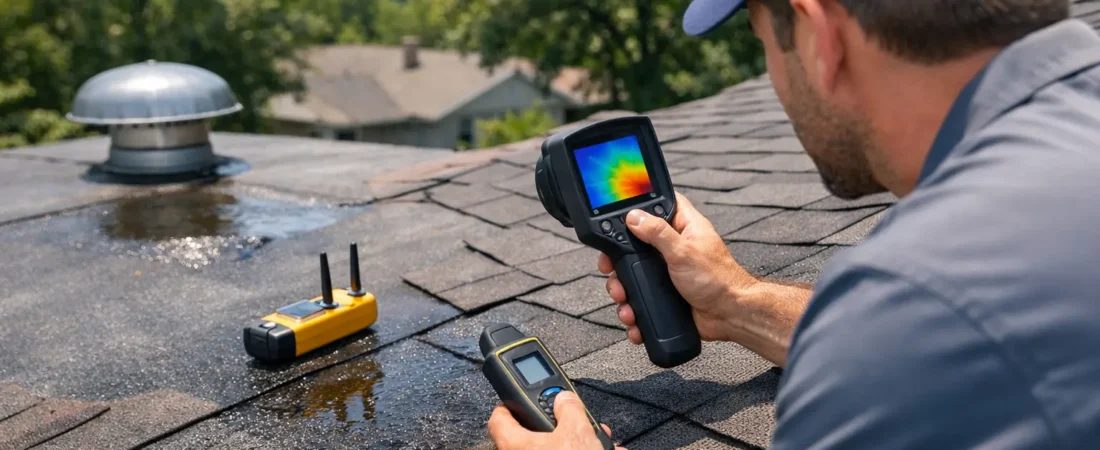
Thermal imaging in the right conditions
Thermal imaging can sometimes identify temperature differences associated with retained moisture beneath a roof surface or within accessible roof areas. It can be useful on larger, low-slope roofs and where a pattern of dampness is suspected but not visible.
However, thermal imaging does not directly see water. Sun exposure, cloud cover, heating inside the building and the time of day can all affect readings. It should be treated as an investigative tool, not a standalone answer. Confirming the result through visual inspection and moisture testing is essential before specifying repairs.
Common leak locations that deserve close attention
Roof leaks often occur at transitions rather than across the main field of tiles or slates. Chimney flashings, valleys, roof windows, dormer cheeks, soil vent penetrations, ridge details and junctions between roof types are frequent risk areas. Gutters and outlets also matter: an overflowing gutter can force water behind fascia boards or saturate a vulnerable roof edge.
On flat roofs, leaks commonly develop at laps, penetrations, outlets, perimeter details and areas of ponding. On tiled or slated roofs, broken coverings may be the visible problem, but degraded underlay, failed nail fixings or poor detailing around an abutment may be the reason water reaches the interior.
Storm damage should be assessed promptly. A tile that has shifted slightly in high winds can allow intermittent ingress long before it falls or becomes obvious from the ground. Clear photographs and a dated roof condition report are useful where an insurance claim or repair decision depends on demonstrating the extent and likely cause of damage.
When a professional leak investigation is the sensible choice
A basic ground-level check may be enough when a clearly damaged tile is easy to identify and safely repair. A specialist assessment is more appropriate when the leak returns after repair, staining is spreading, the roof is high or inaccessible, storm damage is suspected, or a property purchase or insurance claim requires independent evidence.
The useful outcome is not just a statement that a roof has a leak. A decision-ready report should identify the probable source, record relevant defects with photographs, explain the level of urgency and distinguish essential repair work from maintenance items. For a buyer, that can inform negotiations. For a landlord or property manager, it helps prioritise repair budgets. For an insurer, it creates a clear record of the roof condition and observed damage.
Super Roof Inspector approaches leak investigations as a roofing-specific assessment, using the most suitable combination of close inspection, drone imaging and evidence-led reporting for the property. The aim is to replace uncertainty with clear, practical next steps.
If water has appeared indoors, photograph the affected area, note the weather conditions and avoid assuming the stain marks the entry point. Acting early with a focused roof assessment gives you a better chance of stopping a small defect before it becomes a larger repair.